Extending the Crate
Tutorials for writing your own AtomRestraint / Region / Callback types,
plus the in-loop optimizer seam and the Stage seam every packing algorithm
implements. Every extension trait in this crate follows the same shape
(direction-3 rule — see concepts):
pub trait X+ N concretepub structtypes implementing it. User typesimpl Xidentically. No built-in/plugin type-level distinction.
Custom AtomRestraint
Goal: pull atoms toward a target plane with a quadratic attractive well.
Step 1 — define the struct
use molrs::op::F;
# use molpack::AtomRestraint;

#[derive(Debug, Clone, Copy)]
pub struct PlaneTether {
    pub normal: [F; 3],
    pub offset: F,
    pub k: F,
}
# impl AtomRestraint for PlaneTether {
#     fn f(&self, _x: &[F; 3], _s: F, _s2: F) -> F { 0.0 }
#     fn fg(&self, _x: &[F; 3], _s: F, _s2: F, _g: &mut [F; 3]) -> F { 0.0 }
# }
pubfields — users construct withPlaneTether { normal, offset, k }, no builder.Debugrequired becauseAtomRestrainthas aDebugsupertrait bound (soTarget's derivedDebugkeeps working).
Step 2 — implement AtomRestraint
# use molrs::op::F;
# use molpack::AtomRestraint;
# #[derive(Debug)]
# pub struct PlaneTether { pub normal: [F; 3], pub offset: F, pub k: F }
impl AtomRestraint for PlaneTether {
    fn f(&self, pos: &[F; 3], _scale: F, _scale2: F) -> F {
        let d = self.normal[0] * pos[0]
              + self.normal[1] * pos[1]
              + self.normal[2] * pos[2]
              - self.offset;
        0.5 * self.k * d * d
    }
    fn fg(&self, pos: &[F; 3], scale: F, scale2: F, g: &mut [F; 3]) -> F {
        let d = self.normal[0] * pos[0]
              + self.normal[1] * pos[1]
              + self.normal[2] * pos[2]
              - self.offset;
        g[0] += self.k * d * self.normal[0];
        g[1] += self.k * d * self.normal[1];
        g[2] += self.k * d * self.normal[2];
        self.f(pos, scale, scale2)
    }
}
Three contracts that all restraints must obey:
- Gradient accumulates with
+=. Multiple restraints may touch the same atom. fgreturns the value. The hot path uses the returned value for thefdist/frestaccumulation — don't return0.0just because the caller might discard it.- Scale/scale2 usage is your choice. Linear-penalty restraints
typically use
scale; quadratic-penalty ones usescale2. Your tether uses its ownk— ignore both knobs if you prefer.
Step 3 — write a gradient test
# use molrs::op::F;
# use molpack::AtomRestraint;
# #[derive(Debug)] pub struct PlaneTether { pub normal: [F; 3], pub offset: F, pub k: F }
# impl AtomRestraint for PlaneTether {
#     fn f(&self, _x: &[F; 3], _s: F, _s2: F) -> F { 0.0 }
#     fn fg(&self, _x: &[F; 3], _s: F, _s2: F, _g: &mut [F; 3]) -> F { 0.0 }
# }
#[test]
fn plane_tether_gradient_matches_fd() {
    let r = PlaneTether { normal: [0.0, 0.0, 1.0], offset: 5.0, k: 2.0 };
    let x = [1.0, 2.0, 7.0];
    let mut g = [0.0; 3];
    let _ = r.fg(&x, 1.0, 1.0, &mut g);
    let h: F = 1e-5;
    for k in 0..3 {
        let mut xp = x; xp[k] += h;
        let mut xm = x; xm[k] -= h;
        let fd = (r.f(&xp, 1.0, 1.0) - r.f(&xm, 1.0, 1.0)) / (2.0 * h);
        assert!(
            (g[k] - fd).abs() < 1e-4,
            "axis {k}: analytic={}, fd={}", g[k], fd,
        );
    }
}
Convention: ε = 1e-5, tolerance 1e-3 (looser if the restraint has
kinks).
Step 4 — use it
# use molrs::op::F;
# use molpack::AtomRestraint;
# #[derive(Debug, Clone, Copy)] pub struct PlaneTether { pub normal: [F; 3], pub offset: F, pub k: F }
# impl AtomRestraint for PlaneTether {
#     fn f(&self, _x: &[F; 3], _s: F, _s2: F) -> F { 0.0 }
#     fn fg(&self, _x: &[F; 3], _s: F, _s2: F, _g: &mut [F; 3]) -> F { 0.0 }
# }
use std::sync::Arc;
use molpack::{RegionRestraint, Target};
use molrs::core::Cuboid;
use ndarray::array;
# let (pos, rad) = (&[[0.0; 3]][..], &[1.0][..]);

let cube = Cuboid::new(array![0.0, 0.0, 0.0], array![40.0, 40.0, 40.0]);
let target = Target::from_coords(pos, rad, 100)
    .with_restraint(RegionRestraint(Arc::new(cube)))
    .with_restraint(PlaneTether { normal: [0.0, 0.0, 1.0], offset: 20.0, k: 1.0 });
The region lift RegionRestraint and the user PlaneTether take the same
code path — direction-3 in action.
In Python — the same restraint, duck-typed
The interfaces are also exposed to Python through a duck-typed protocol: a
restraint is any object exposing f and fg, and the packer consumes it on the
same code path as a built-in. That makes Python the natural place to prototype
a restraint the input grammar can't express — a few lines, no recompile — and
then, once it earns its place, swap in the native equivalent with the driver
script unchanged.
A duck-typed restraint is any object exposing f and fg. The Python protocol
differs from the Rust trait in exactly one way: fg returns
(energy, (gx, gy, gz)) instead of accumulating into a &mut [F; 3] — the
binding does the += for you. The contracts are otherwise identical: fg
returns the energy, the gradient is the chain rule (dU/dξ)·∇ξ, a linear-energy
penalty rides scale (a quadratic one scale2). A missing f or fg is
rejected at attach time with a TypeError, and an exception raised inside fg
propagates back out of run. The PlaneTether above, duck-typed in Python:
import numpy as np

class PlaneTether:
    """Pull a site toward the plane z = offset (a per-site geometric bias)."""
    def __init__(self, normal, offset, k):
        n = np.asarray(normal, float)
        self.n, self.offset, self.k = n / np.linalg.norm(n), offset, k

    def f(self, x, scale, scale2):
        d = float(self.n @ np.asarray(x, float)) - self.offset
        return scale * 0.5 * self.k * d * d

    def fg(self, x, scale, scale2):
        d = float(self.n @ np.asarray(x, float)) - self.offset
        g = scale * self.k * d * self.n
        return scale * 0.5 * self.k * d * d, (float(g[0]), float(g[1]), float(g[2]))
Attach it with with_atom_restraint (a site subset) or with_restraint (every
copy), and pack.
A per-site field cannot reproduce a distribution. It is tempting to build a per-site penalty from a target density
ρ*(e.g. Boltzmann inversionU = −kT·ln ρ*) to make sites followρ*. This fails under packing's energy minimisation:∑ᵢ U(xᵢ)is minimised by driving every site to the single minimum ofU— the mode ofρ*— so the sites collapse onto the peak instead of spreading over the distribution. To drive a whole species onto a target profile, use a collective restraint (Target.with_collective_restraint, e.g. the built-inTabulatedPlane), whose penalty is a function of the entire group and whose gradient couples the copies, so the fixed point is empirical distribution = target.
Custom Region
A region is molrs vocabulary: implement
[molrs::core::Region] and lift it with
RegionRestraint. Goal: a conical region with
apex at origin, axis along +z, half-angle 30°.
use molrs::core::Region;
use molrs::op::{F, Fnx3};
use ndarray::Array2;

#[derive(Debug, Clone, Copy)]
pub struct Cone {
    pub apex: [F; 3],
    pub axis: [F; 3],
    pub half_angle_cos: F,
}

impl Region for Cone {
    fn bounds(&self) -> Fnx3 {
        // Unbounded along the axis; ±∞ is the honest answer.
        let mut b = Array2::zeros((3, 2));
        for d in 0..3 {
            b[[d, 0]] = F::NEG_INFINITY;
            b[[d, 1]] = F::INFINITY;
        }
        b
    }
    fn distance(&self, x: &[F; 3]) -> F {
        let dx = x[0] - self.apex[0];
        let dy = x[1] - self.apex[1];
        let dz = x[2] - self.apex[2];
        let r = (dx * dx + dy * dy + dz * dz).sqrt();
        if r < 1e-12 { return 0.0; }
        let axis_dot =
            (dx * self.axis[0] + dy * self.axis[1] + dz * self.axis[2]) / r;
        // Not Euclidean, but the sign and the gradient direction are right,
        // which is all the lift needs.
        self.half_angle_cos - axis_dot
    }
    // The default `distance_grad` is a finite difference — fine for a
    // prototype; override analytically for hot-path use (below).
}
Compose with built-ins
# use molrs::core::Region;
# use molrs::op::{F, Fnx3};
# use ndarray::Array2;
# #[derive(Debug, Clone, Copy)]
# pub struct Cone { pub apex: [F; 3], pub axis: [F; 3], pub half_angle_cos: F }
# impl Region for Cone {
#     fn bounds(&self) -> Fnx3 { Array2::zeros((3, 2)) }
#     fn distance(&self, _x: &[F; 3]) -> F { 0.0 }
# }
use std::sync::Arc;
use molpack::{RegionRestraint, Target};
use molrs::core::{AndRegion, Sphere};
use ndarray::array;
# let (pos, rad) = (&[[0.0; 3]][..], &[1.0][..]);

let cone = Cone {
    apex: [0.0; 3],
    axis: [0.0, 0.0, 1.0],
    half_angle_cos: (std::f64::consts::PI / 6.0).cos(),
};
let sphere = Sphere::new(array![0.0, 0.0, 0.0], 10.0);
let region = AndRegion::new(Arc::new(cone), Arc::new(sphere));

let target = Target::from_coords(pos, rad, 100)
    .with_restraint(RegionRestraint(Arc::new(region)));
AndRegion / OrRegion / NotRegion take Arc<dyn Region + Send + Sync>:
one algebra for Rust, for Python (&, |, ~), and for a region handed
across the wheel boundary.
Analytic gradient override
For hot-path use, override distance_grad analytically. The cone above:
# use molrs::core::Region;
# use molrs::op::{F, Fnx3};
# use ndarray::Array2;
# #[derive(Debug, Clone, Copy)]
# pub struct Cone { pub apex: [F; 3], pub axis: [F; 3], pub half_angle_cos: F }
# impl Region for Cone {
#     fn bounds(&self) -> Fnx3 { Array2::zeros((3, 2)) }
#     fn distance(&self, _x: &[F; 3]) -> F { 0.0 }
fn distance_grad(&self, x: &[F; 3]) -> [F; 3] {
    let dx = x[0] - self.apex[0];
    let dy = x[1] - self.apex[1];
    let dz = x[2] - self.apex[2];
    let r2 = dx * dx + dy * dy + dz * dz;
    let r = r2.sqrt();
    if r < 1e-12 { return [0.0; 3]; }
    let axis_dot = (dx * self.axis[0] + dy * self.axis[1] + dz * self.axis[2]) / r;
    let inv_r = 1.0 / r;
    // distance = cos(α) - axis_dot ⇒ grad = -∂axis_dot/∂x
    [
        -(self.axis[0] * inv_r - axis_dot * dx * inv_r * inv_r),
        -(self.axis[1] * inv_r - axis_dot * dy * inv_r * inv_r),
        -(self.axis[2] * inv_r - axis_dot * dz * inv_r * inv_r),
    ]
}
# }
Then finite-difference check it — same pattern as the AtomRestraint
test.
Custom Callback
Goal: a callback that writes a CSV row per step so you can plot the objective evolution.
use std::fs::File;
use std::io::{BufWriter, Write};
use molpack::{Callback, PackSystem, StepReport};
use molrs::op::F;

pub struct CsvCallback { writer: BufWriter<File> }

impl CsvCallback {
    pub fn new(path: &str) -> std::io::Result<Self> {
        let mut w = BufWriter::new(File::create(path)?);
        writeln!(w, "phase,loop_idx,fdist,frest,improvement_pct")?;
        Ok(Self { writer: w })
    }
}

impl Callback for CsvCallback {
    fn on_step(&mut self, step: &StepReport, _sys: &PackSystem) {
        let _ = writeln!(
            self.writer,
            "{},{},{},{},{}",
            step.phase.phase,
            step.loop_idx,
            step.fdist,
            step.frest,
            step.improvement_pct,
        );
    }
}
Callback notes:
on_stepis the only required method. Everything else has a default no-op.sysis&PackSystem, never&mut. Callbacks cannot mutate packer state — bind an in-loop optimizer (next section) if you need to.- Multiple callbacks run in registration order. Register your CSV
callback before
ProgressCallbackto get a row on every step, vice-versa otherwise. should_stopis polled every iteration. Returntrueto break the outer loop early. Useful for time budgets or custom convergence criteria.- Every step names its stage.
step.stageis aStageProgress—index,total,name— identifying the packing algorithm that emitted the step (stages are the subject of theStagesection below). A run driven by one engine has one stage, so it reportsindex = 0andtotal = 1. Theon_stage_start/on_stage_endhooks bracket a whole stage the wayon_phase_start/on_phase_endbracket one GENCAN phase; both are no-op defaults, and a single-stage run calls neither.
Custom in-loop optimizer
Everything above places molecules as rigid bodies: the packer moves and turns a copy, but the copy's internal shape — its conformer — stays frozen at whatever the template said. A flexible molecule often cannot satisfy its restraints in any single rigid pose; it has to change shape while it is being placed.
That is what an in-loop optimizer is for. Once per outer packing iteration,
the packer hands each selected copy to an object that may rewrite that copy's
coordinates, and keeps the result only if the packing objective did not get
worse. The seam is molrs's Optimizer trait — one method, which relaxes a
Frame (molrs's atomic-data container) in place:
pub trait Optimizer: Send + Sync {
    fn minimize(&mut self, frame: &mut Frame) -> Result<OptimizationReport, String>;
}
molpack ships one implementation, TorsionMcOptimizer: Metropolis
Monte-Carlo sampling of rotations about a molecule's rotatable bonds.
("Metropolis Monte-Carlo" means propose a random move, then accept it with
probability min(1, exp(-ΔE / T)) — downhill moves always pass, uphill ones
sometimes do, which is what lets the search escape a bad local shape.) molrs
ships Lbfgs, a force-field minimizer. Anything else implementing the trait
drops into the same slot.
The trait, its molpack implementation, and the GencanPack::with_optimizer
binder are always compiled. Binding a molrs force-field optimizer such as
Lbfgs needs molrs's ff module: turn on ff in your own molcrafts-molrs
dependency (molpack has no ff feature of its own).
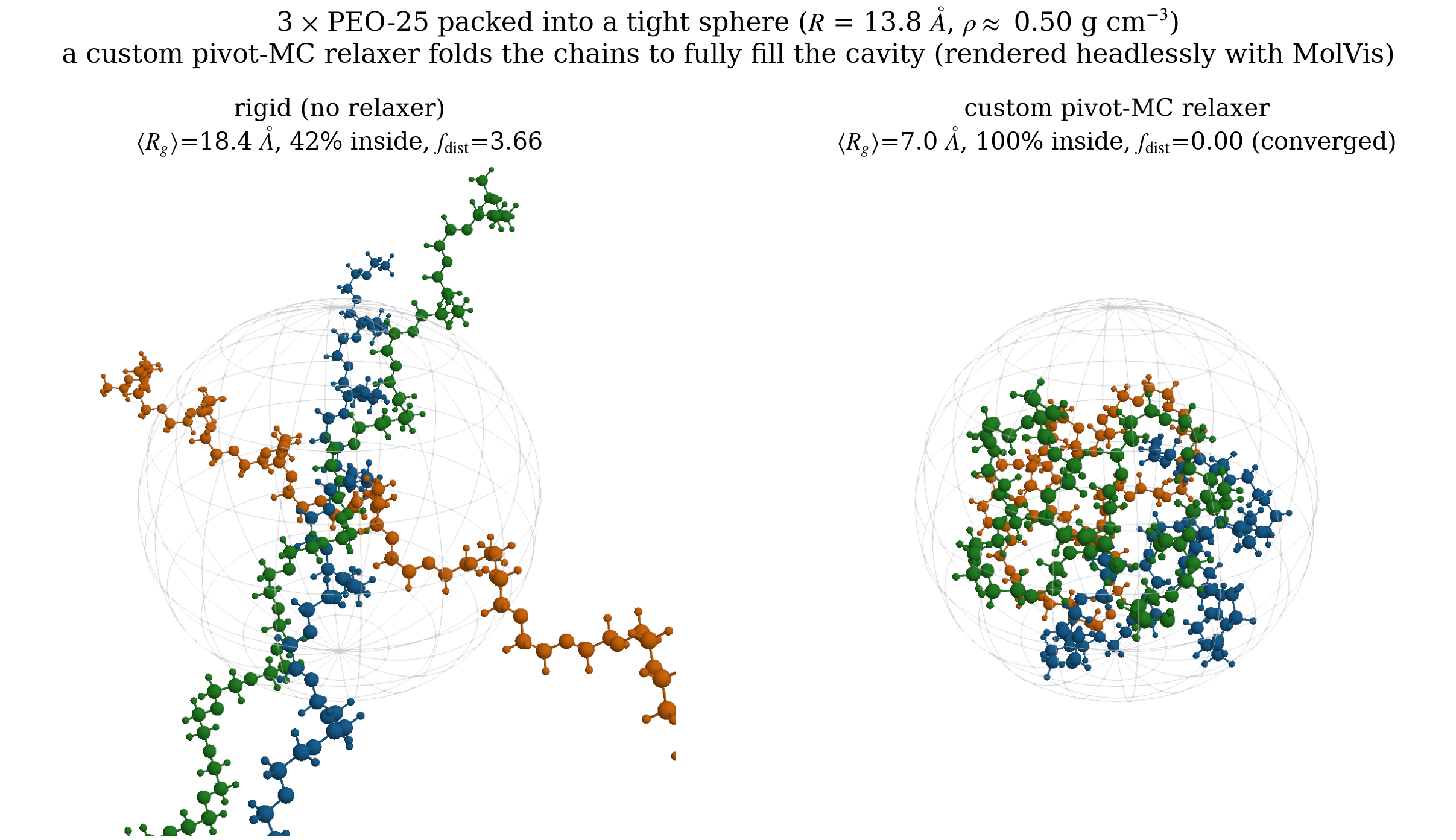
Confinement like this is a molpack extension workflow, not a Packmol parity
claim: an in-loop optimizer reshapes flexible chains while the packer places
them, so one engine can fit them inside a cavity no rigid pose would clear.
Two runnable programs drive TorsionMcOptimizer exactly this way —
cargo run --release --example pack_adsorption --features io and
cargo run --release --example pack_translocation --features io.
Step 1 — implement Optimizer
Goal: a jiggle optimizer that proposes random rigid translations of the group it is handed and keeps the ones that lower a score. A real optimizer scores with a force field; this one just pulls the group toward the origin, so the mechanics stay visible.
Two conventions the packer relies on:
- Coordinates arrive and leave through the
Frame. Read them withFrame::coords— anN × 3array in ångström — and write them back withFrame::set_coords. - Frozen atoms are flagged. When the binding asks for the local
environment, the
Framealso carries neighbouring atoms that must not move. They are marked by a booleanatoms.freecolumn; a missing column means every atom is free.
use molrs::core::Frame;
use molrs::optimize::{OptimizationReport, Optimizer};
use molrs::op::{F, Fnx3};
use rand::rngs::SmallRng;
use rand::{RngExt, SeedableRng};

pub struct JiggleOptimizer {
    /// Trial moves per call.
    pub steps: usize,
    /// Largest displacement per axis, in ångström.
    pub max_delta: F,
    rng: SmallRng,
}

impl JiggleOptimizer {
    pub fn new(steps: usize, max_delta: F, seed: u64) -> Self {
        Self { steps, max_delta, rng: SmallRng::seed_from_u64(seed) }
    }
}

/// Toy score (Ų): squared distance of the free atoms from the origin.
fn score(coords: &Fnx3, free: &[bool]) -> F {
    coords
        .rows()
        .into_iter()
        .zip(free)
        .filter(|(_, free)| **free)
        .map(|(r, _)| r.dot(&r))
        .sum()
}

impl Optimizer for JiggleOptimizer {
    fn minimize(&mut self, frame: &mut Frame) -> Result<OptimizationReport, String> {
        let mut best = frame.coords().map_err(|e| e.to_string())?;
        let n = best.nrows();
        let free: Vec<bool> = match frame
            .get("atoms")
            .and_then(|a| a.get("free"))
            .and_then(|c| c.as_bool())
        {
            Some(col) if col.len() == n => col.iter().copied().collect(),
            _ => vec![true; n],
        };

        let max_delta = self.max_delta;
        let mut best_score = score(&best, &free);
        let mut accepted = 0usize;

        for _ in 0..self.steps {
            let d = [
                self.rng.random_range(-max_delta..max_delta),
                self.rng.random_range(-max_delta..max_delta),
                self.rng.random_range(-max_delta..max_delta),
            ];
            let mut trial = best.clone();
            for i in 0..n {
                if !free[i] {
                    continue; // never move a frozen environment atom
                }
                for k in 0..3 {
                    trial[[i, k]] += d[k];
                }
            }
            let trial_score = score(&trial, &free);
            if trial_score < best_score {
                best = trial;
                best_score = trial_score;
                accepted += 1;
            }
        }

        frame.set_coords(best.view()).map_err(|e| e.to_string())?;
        Ok(OptimizationReport {
            converged: accepted > 0,
            n_steps: self.steps,
            final_energy: best_score,
            final_fmax: 0.0,
            final_grad_rms: 0.0,
        })
    }
}
Step 2 — bind it to a selection
GencanPack::with_optimizer takes two arguments: an OptimizeSelect saying
which targets the optimizer sees and how, then the optimizer itself.
OptimizeSelect::per_copy(names) hands over one copy at a time;
OptimizeSelect::joint(names) hands over every copy of the named targets as a
single movable group. .with_environment(rcut) additionally includes every
atom within rcut ångström as frozen context, so a chain folds against its
real neighbours rather than empty space.
# use molrs::{core::Frame, optimize::{OptimizationReport, Optimizer}, op::F};
# struct JiggleOptimizer;
# impl JiggleOptimizer { fn new(_: usize, _: F, _: u64) -> Self { Self } }
# impl Optimizer for JiggleOptimizer {
#     fn minimize(&mut self, _: &mut Frame) -> Result<OptimizationReport, String> { unimplemented!() }
# }
# let targets: Vec<molpack::Target> = Vec::new();
use molpack::{GencanPack, OptimizeSelect, PackEngine};

let result = GencanPack::new()
    .with_tolerance(2.0)
    .with_optimizer(
        OptimizeSelect::per_copy(["chain"]).with_environment(8.0),
        JiggleOptimizer::new(25, 0.5, 42),
    )
    .run(&targets, 200)?;
# Ok::<(), molpack::PackError>(())
Optimizer notes:
- Bindings run in the all-type phase only. That is the phase whose coordinate vector holds every molecule, so per-copy indexing is unambiguous.
- Non-harm is the packer's job, not yours. After write-back molpack
re-evaluates the packing objective and reverts your conformer if it got
worse. A
runthat makes things worse wastes time; it cannot break a pack. - A binding is matched by target name.
Target::with_name("chain")is whatOptimizeSelect::per_copy(["chain"])looks up; an unmatched name is skipped with a log warning, which is the usual cause of "my optimizer never ran". - Copies diverge. Under
per_copy, each copy's reference conformer is relaxed independently, so copies of one target stop sharing a shape.
Custom Stage — a whole packing algorithm
Everything above plugs into an algorithm that already exists: a restraint
changes what the packer tries to satisfy, a callback watches it work, an
in-loop optimizer reshapes molecules while it runs. Replacing the algorithm
itself — how molecules get from nothing to a non-overlapping arrangement — is
what the Stage seam is for.
A stage is one packing algorithm behind four methods. molpack ships three:
GencanStage (rigid-body descent on the shared objective), GrowStage
(configurational-bias chain growth) and LatticeStage (a self-avoiding walk on
a diamond lattice). They are peers — no stage reaches into another stage's
driver — and each is judged afterwards by the same objective, so none of them
can grade its own work.
pub trait Stage: Send {
    fn name(&self) -> &'static str;
    fn requires(&self) -> Requires;
    fn guarantees(&self) -> Guarantees;
    fn run(&mut self, state: &mut PackState, targets: &[Target],
           budget: &Budget, callbacks: &mut [Box<dyn Callback>])
           -> Result<StageOutcome, PackError>;
}
Of the four arguments to run, state is the run's geometry — the subject of
the next section — while targets are the molecule types the caller passed to
the engine's run, budget is the caller's iteration allowance, and
callbacks are the observers to notify while you work.
run itself returns a Result, not a bare outcome: a stage that cannot do
its job fails with a named PackError, never by
returning Ok with converged: false. The two report different things —
converged = false is the honest "I ran to completion and did not reach my
own criterion", while Err is "I could not complete the run at all" — and
collapsing the second into the first would let an outright failure through
disguised as a merely unconverged run. The lifecycle propagates that Err out
of PackEngine::run on the same path as its own
validation errors: the failing stage gets no on_stage_end, the run gets no
on_finish, and no half-built result is assembled. molpack's three built-in
stages always return Ok.
The state a stage is handed
run takes a &mut PackState, which carries three things:
- a
PackSystem— the run's mutable geometry: per-atom radii, the restraint pool, the cell list, andxcart, the lab-frame coordinates, meaning where each atom actually sits in the packing cell; - a
RigidView— the rigid placement vector: for every free molecule a centre of mass and three Euler angles (the three-parameter description of that molecule's orientation). It is6 · nmolnumbers, the centre-of-mass block first, then the Euler block; - a
Placedmarker —Placed::None(nothing placed yet) orPlaced::All(every free molecule has a placement).
Take the first two apart with state.rigid_split_mut(), which hands back
(&mut PackSystem, &mut RigidView) as two disjoint borrows.
Two coordinate frames meet inside the system. sys.coor holds each copy's
reference conformer — its atoms measured from that copy's own centre of
mass with no orientation applied, so it describes the molecule's shape and
nothing else. sys.xcart holds the lab-frame positions. The two are related by
xcart = com + R(euler) · coor, where R(euler) is the rotation matrix built
from the three Euler angles.
That relation decides where a stage must leave its answer. A stage writes
placements into the RigidView; once run returns, the lifecycle rebuilds
xcart from them with RigidView::write_xcart. A stage that instead works
directly in lab-frame coordinates — both growth stages do, because a chain is
grown atom by atom — must capture them back into placements with
RigidView::capture_from_xcart before returning. Anything left only in xcart
is overwritten.
What requires and guarantees declare
Both are one-field records over the Placed marker above:
Requires::new(Placed::All) says "hand me a state whose molecules are already
placed"; Guarantees::new(Placed::All) says "when I return, every free
molecule has a placement". They are declarations, not checks — the lifecycle
advances the state's marker to whatever the stage guaranteed, never by
inspecting what it actually did. Declaring them truthfully is what lets a
caller decide which stages may legally follow which.
Both types are #[non_exhaustive], so build them with ::new rather than a
struct literal; that is what lets a second precondition be added later without
breaking your code.
Re-entrancy: never consume your own configuration
A stage may be run more than once on an evolving state. The rule that falls
out of that is short: the second run must have every capability the first
had. The only thing a call may consume is scratch it created itself.
The contract is not decorative. A stage that moves its bound in-loop
optimizers out of self on the first call keeps running from the second call
on, just degraded — with no error and no name for what it lost. Borrow your
configuration, do not take it.
StageOutcome carries no verdict
run returns Ok(StageOutcome::new(converged, degraded)) on a successful
run, and those two numbers are all a stage reports: whether it met its own
convergence criterion, and how
many times it had to relax a constructive guarantee (growth's hard-core
softening rungs; always 0 on the rigid-body path, which relaxes nothing). The
run's verdict — the largest inter-molecular overlap fdist and the largest
restraint violation frest — is read off the system after run returns, by
the shared objective. That is the one-ruler rule: no algorithm reports its own
score.
A minimal stage
use molpack::{Budget, Guarantees, Callback, PackError, PackState, Placed, Requires, Stage, StageOutcome, Target};
use molrs::op::F;

/// Nudges every molecule by a fixed offset. Not useful — just the smallest
/// thing that is still a stage.
struct ShakeStage {
    /// Displacement added to each centre of mass, in ångström.
    step: [F; 3],
}

impl Stage for ShakeStage {
    fn name(&self) -> &'static str {
        "shake"
    }

    /// It moves placements that already exist; it never creates them.
    fn requires(&self) -> Requires {
        Requires::new(Placed::All)
    }

    /// It leaves every molecule placed, because it only moved them.
    fn guarantees(&self) -> Guarantees {
        Guarantees::new(Placed::All)
    }

    fn run(
        &mut self,
        state: &mut PackState,
        _targets: &[Target],
        _budget: &Budget,
        _callbacks: &mut [Box<dyn Callback>],
    ) -> Result<StageOutcome, PackError> {
        // `self.step` is read, never taken — re-entrancy contract.
        let (_sys, x) = state.rigid_split_mut();
        for i in 0..x.nmol() {
            let com = x.com(i);
            x.set_com(
                i,
                [
                    com[0] + self.step[0],
                    com[1] + self.step[1],
                    com[2] + self.step[2],
                ],
            );
        }
        // Placements only: the lifecycle expands them into `xcart`.
        Ok(StageOutcome::new(true, 0))
    }
}
Wiring it into a run
A stage does not run itself. The lifecycle around it — validation, restraint
broadcast, system construction, callback bracketing, the lab-frame rebuild,
frame assembly — lives in exactly one place: Pipeline's
run, reached through the
PackEngine trait. An engine is a type that plugs into
that lifecycle by implementing StageFactory; its
stages method is the one thing an engine must supply: the stage(s) it drives,
built from the run's resolved EngineSetup.
PackEngine then adds the shared with_* builders plus a one-line run that
hands the engine to the lifecycle as its sole stage source
(Pipeline::single(self).run(targets, max_loops)) — the same code path a
hand-composed pipeline runs, not a second implementation to keep in step.
# struct ShakeStage { step: [molrs::op::F; 3] }
# impl molpack::Stage for ShakeStage {
#     fn name(&self) -> &'static str { "shake" }
#     fn requires(&self) -> molpack::Requires { molpack::Requires::new(molpack::Placed::All) }
#     fn guarantees(&self) -> molpack::Guarantees { molpack::Guarantees::new(molpack::Placed::All) }
#     fn run(&mut self, _state: &mut molpack::PackState, _targets: &[molpack::Target],
#            _budget: &molpack::Budget, _callbacks: &mut [Box<dyn molpack::Callback>])
#            -> Result<molpack::StageOutcome, molpack::PackError> {
#         Ok(molpack::StageOutcome::new(true, 0))
#     }
# }
use molpack::EngineSetup;
use molpack::{Callback, PackEngine, PackError, PackSettings, Pipeline, Stage, StageFactory};
use molrs::op::F;

pub struct ShakePack {
    settings: PackSettings,
    callbacks: Vec<Box<dyn Callback>>,
    step: [F; 3],
}

impl ShakePack {
    pub fn new(step: [F; 3]) -> Self {
        Self { settings: PackSettings::default(), callbacks: Vec::new(), step }
    }
}

impl StageFactory for ShakePack {
    fn settings(&self) -> &PackSettings {
        &self.settings
    }

    fn take_callbacks(&mut self) -> Vec<Box<dyn Callback>> {
        std::mem::take(&mut self.callbacks)
    }

    /// The factory's single contribution: which stage(s) this run drives.
    fn stages(&mut self, _setup: &EngineSetup<'_>) -> Result<Vec<Box<dyn Stage>>, PackError> {
        Ok(vec![Box::new(ShakeStage { step: self.step })])
    }
}

impl PackEngine for ShakePack {
    fn settings_mut(&mut self) -> &mut PackSettings {
        &mut self.settings
    }
    fn callbacks_mut(&mut self) -> &mut Vec<Box<dyn Callback>> {
        &mut self.callbacks
    }

    /// One line: hand the engine to the crate's one lifecycle body as its
    /// sole stage source — every preset writes exactly this.
    fn run(
        self,
        targets: &[molpack::Target],
        max_loops: usize,
    ) -> Result<molpack::State, PackError> {
        Pipeline::single(self).run(targets, max_loops)
    }
}
ShakePack has every shared builder (with_seed, with_tolerance,
with_callback, with_global_restraint, …) and the terminal
run(&targets, max_loops), exactly like GencanPack, because all of them are
provided methods on PackEngine. EngineSetup (the resolved targets, cell and
system shape) is the one thing stages reads to build its stage(s) from —
there is no separate hook for pre-loading a placement vector before a stage
runs. Instead, each stage's own run does that as its own prelude: the
shipped GENCAN stage installs its grid, and — only if it inherited a seed via
with_restart — copies the seed's placements in, before deciding whether to
skip initial() and continue from what is already there.
Composing stages
A single-engine run is Pipeline::single(self) under the hood, so the same
lifecycle also runs a hand-built sequence of stages directly, with no engine
type of your own. Pipeline::new builds an
empty pipeline; with_stage appends
one factory at a time — a chain grower feeding a rigid-body packer, for
example:
use molpack::grow::TorsionPrior;
use molpack::{CbmcGrow, GencanPack, PackEngine, Pipeline, Target};
# let targets: Vec<Target> = Vec::new();
let result = Pipeline::new()
    .with_stage(CbmcGrow::new(TorsionPrior::Uniform))
    .with_stage(GencanPack::new())
    .with_seed(42)
    .with_periodic_box([0.0; 3], [30.0; 3], [true; 3])
    .run(&targets, 100)?;
# Ok::<(), molpack::PackError>(())
with_stage treats what a factory carries two ways, so nothing is silently
dropped. Its callbacks are adopted — appended to the pipeline's own set in
stage order, so they go on to observe every stage in the run, not just the one
that carried them in. Its shared settings are refused the moment any knob
is off its default (PackError::PresetSettingsInsidePipeline, naming the
offending knob) — tolerance, precision, seed and the cell are one ruler shared
by the whole run, and two stages each bringing their own would leave the
objective with no single ruler to read. That is why the example above sets
with_seed and with_periodic_box on the Pipeline itself rather than on
CbmcGrow or GencanPack: those knobs belong to the run, never to one stage
inside it.
Custom invariants and combinators
Composing stages linearly, as above, covers a pipeline whose stages each run
once. Two situations need more than that: repeating a body of stages until
some condition is met, and refusing to accept a stage's exit until a property
of the resulting state has been verified. molpack answers both with an
Invariant trait plus two Stage combinators,
Pipeline::with_repeat and
Pipeline::with_guarded.
An Invariant is a property of a
PackState a caller can demand — "restraints are
satisfied within tolerance", say — checked after a stage has already run.
It is never a second algorithm competing with the stage itself:
pub trait Invariant: Send {
    fn name(&self) -> &'static str;
    fn layer(&self) -> Layers;
    fn check(&self, state: &PackState) -> Vec<Violation>;
}
check reads the shared objective's own verdict off the state — the same
fdist / frest numbers StageOutcome deliberately
does not carry — and reports every way the property is broken as a
Violation, or an empty Vec when it holds. An invariant
that computed its own second measure of "is this satisfied" would be exactly
the mistake the one-ruler rule exists to catch, so reuse the objective's
numbers rather than re-deriving them; molpack's own
RestraintsSatisfied does this by comparing
state.sys().frest against a tolerance. layer names which rung of the
repair-cost ladder (Layers, documented where it is
consumed) a violation sits on — from a wrong bond graph that nothing
downstream can repair, to bond lengths and angles a downstream force-field
minimization fixes for free — which is what tells a caller whether rerunning
the same stage can plausibly help at all.
The smallest possible invariant, useful as a placeholder while wiring up a guarded stage:
use molpack::{Invariant, Layers, PackState, Violation};

#[derive(Debug, Clone, Copy)]
pub struct AlwaysSatisfied;

impl Invariant for AlwaysSatisfied {
    fn name(&self) -> &'static str {
        "always-satisfied"
    }

    fn layer(&self) -> Layers {
        Layers::EMPTY
    }

    fn check(&self, _state: &PackState) -> Vec<Violation> {
        vec![]
    }
}
Two combinators build on Invariant, and are themselves
Stages — the pipeline needs no branch for either, because
chain-checking, callback bracketing and the run's final verdict read them
exactly as they read GencanPack.
with_repeat(body, until)runs aVec<Box<dyn StageFactory>>body repeatedly:Until::Passes(n)stops after exactlynpasses (Passes(0)contributes no stage at all, never a silently clamped single pass), andUntil::Convergedstops the first time a pass ends with the body's last stage reporting its own convergence — unbounded by construction, so a body that never converges repeats until a callback asks the run to stop. Each pass continues from where the last one left off, the samePlaced::Allcontinuation a seeded run uses, soRepeataround a chain-growth stage feeding a rigid-body one is a real "connect, then refine, then connect again" recipe rather thannindependent packs.with_guarded(stage, invariants, on_violation)runsstage, then checks every invariant against the state it left. On the first broken one,OnViolationhas exactly two answers, never a third:FailreturnsPackError::InvariantViolatedimmediately;Rerun { max }reruns the same stage up tomaxmore times and, if it is still broken once that budget is spent, reportsconverged: false(logged, not silently dropped) instead of looping forever.Rerun { max: 0 }isFail.
That "same stage or named failure" rule is not an oversight: it is the
project's law that the user picks the packing method — molpack never
guesses on their behalf. A guard that quietly swapped in a different
algorithm when one failed would be exactly that guess, so OnViolation has
no such arm and never will.
use molpack::grow::TorsionPrior;
use molpack::{
    CbmcGrow, GencanPack, Invariant, OnViolation, PackEngine, Pipeline, RestraintsSatisfied,
    StageFactory, Target, Until,
};
# let targets: Vec<Target> = Vec::new();

let body: Vec<Box<dyn StageFactory>> = vec![
    Box::new(CbmcGrow::new(TorsionPrior::Uniform)),
    Box::new(GencanPack::new()),
];
let invariants: Vec<Box<dyn Invariant>> = vec![Box::new(RestraintsSatisfied::new(1e-3))];

let result = Pipeline::new()
    .with_repeat(body, Until::Converged)
    .with_guarded(GencanPack::new(), invariants, OnViolation::Rerun { max: 2 })
    .with_seed(42)
    .with_periodic_box([0.0; 3], [30.0; 3], [true; 3])
    .run(&targets, 100)?;
# Ok::<(), molpack::PackError>(())
Stage notes:
- Pick your own name.
name()is what everyStepReporta callback sees carries instep.stage.name; keep it short and lowercase — the three built-ins report"gencan","growth"and"lattice". targetsis the one source of chemistry. They are the same objects the caller passed torun, so a stage never needs a second copy of the molecule data.budgetis an allowance, not a schedule. Its two fields,max_loopsandprecision, say how much work the caller is willing to pay for and how small the violation maxima must get; how you spend it is your algorithm's business, so your stage should document how it readsmax_loops.- Stages are geometry only. The seam takes no force field and performs no chemistry perception; priors, radii and restraints all arrive as user data on the targets.
Testing discipline
molpack keeps one test tier: unit tests in a #[cfg(test)] module next to
the code that owns the behaviour. There is no tests/ directory, no benchmark
suite and no regression harness — an end-to-end packing scenario belongs in
examples/, not in the test suite.
| Kind | Location | Convention |
|---|---|---|
| Unit test | #[cfg(test)] mod tests in the same file |
One #[test] fn per behavior |
| Large test body | child module (src/grow/tests/, src/pipeline/tests.rs) |
Still --lib, still owned by that module |
| Gradient finite-difference | alongside the unit test | ε=1e-5, tol=1e-3 |
Run all:
Rules:
- Every new
AtomRestraintgets an FD gradient test. - Every new
Regiongets a boolean-algebra + signed-distance sign test and (for hot-path use) an analytic-gradient FD test.
Common pitfalls
- Gradient sign. Every
AtomRestraintaccumulates∂penalty/∂x. Optimizer negates for descent. If your molecules fly out of the region, the gradient has the wrong sign — penalty should point toward the violation boundary. - Rotation convention. Single-atom tests pass with both LEFT and RIGHT Euler multiplication; multi-atom tests don't. Always test Euler changes with ≥ 2 atoms.
Cell<f64>is notSync. UseAtomicU64+f64::to_bits/from_bitsfor interior mutability inSend + Synccontexts.- 0-based atom indexing.
Target::with_atom_restraintuses Rust-native 0-based indices.&[0, 1]selects the first two atoms. Packmol.inpfiles use 1-based — subtract 1 at the parse boundary. - An in-loop optimizer only runs in the all-type phase. If you expected it during per-type pre-compaction, you will see no effect there.
radscaleis phase-dependent. Don't hard-code atomic radii — always go throughsys.radius[i]. The crate-internalevaluate_unscaled(src/system/pack_state.rs) temporarily swapsradiuswithradius_iniso the numbers it reports are unscaled.- PBC boxes must be valid. Zero-length axis returns
PackError::InvalidPbcBox.
Contributing flow
- Write a failing test.
- Implement until it passes.
- Run the full gate: